OKX vs Bitget: real fees, worked in money, straight answer
These are two exchanges ReturnFee has referral links with. Maker fees are identical on both. Standard taker fees are not, OKX is cheaper on every taker fill (0.050% against 0.060%). ReturnFee's Bitget code changes that: Bitget's taker fee drops to 0.040%, below OKX's. Say it straight: after each exchange's rebate Bitget nets lower on taker fills at this tier (0.018% against 0.020%), while OKX nets lower on maker fills, and for a maker-only trader the fee schedule alone does not decide between them.
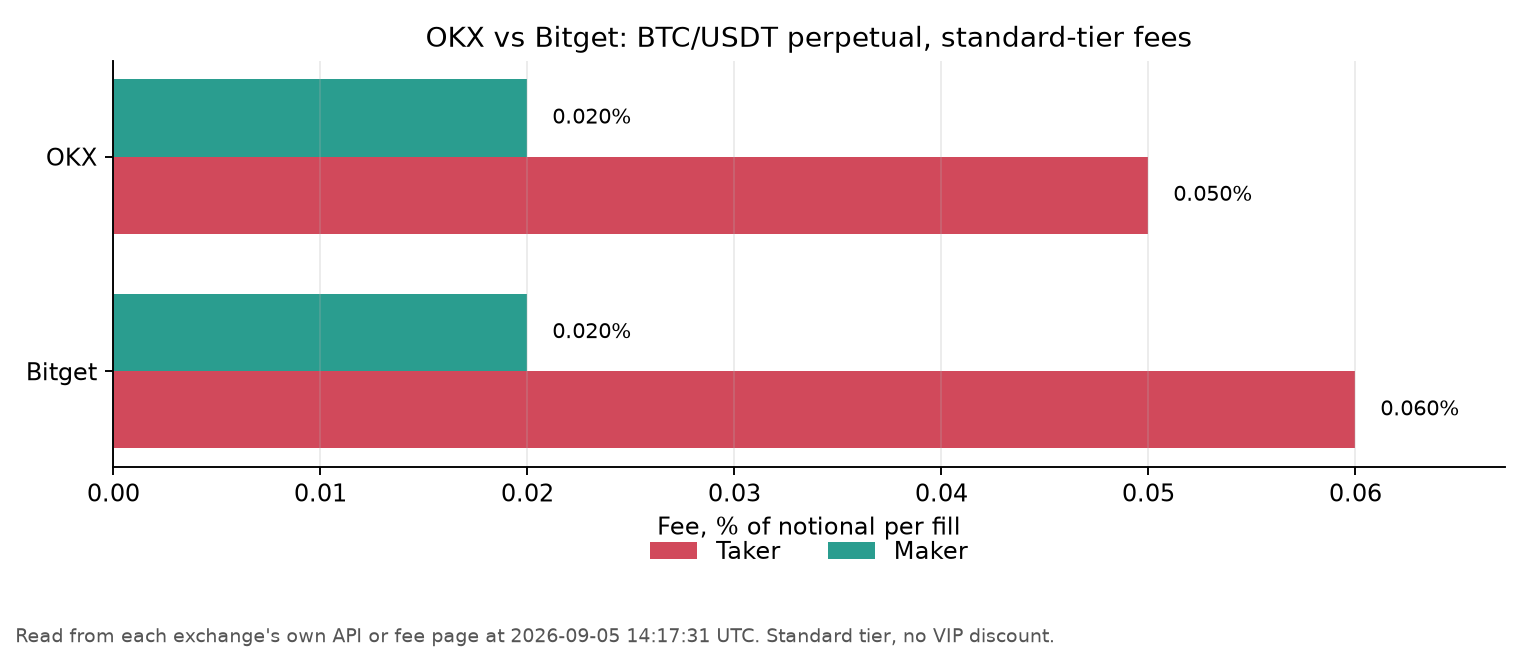
The rates, read straight from each exchange
BTC/USDT perpetual futures, standard tier (VIP 0):
| Exchange | Maker | Taker | Read |
|---|---|---|---|
| OKX | 0.020% | 0.050% | 2026-10-18 |
| Bitget | 0.020% | 0.060% | 2026-10-18 |
| Bitget, with our code | 0.020% | 0.040% | 2026-10-07 |
OKX read from its own published fee-schedule page, verified 2026-10-18: okx.com/fees. Bitget pulled live from its own contract API, also verified 2026-10-18: api.bitget.com/api/v2/mix/market/contracts. The with-code row is Bitget's affiliate setting for accounts that sign up through ReturnFee's link, confirmed 2026-10-07. Machine-readable source: data/fee-rates.json in this site's own repo.
What that costs in money, not percentage
Taker fee, the honest default for anyone acting on a signal rather than sitting on the book, at two volumes, fee = volume × taker rate:
$100,000 traded in a month:
- OKX, $100,000 × 0.050% = $50
- Bitget, $100,000 × 0.060% = $60
- Bitget with our code, $100,000 × 0.040% = $40
$500,000 traded in a month:
- OKX, $500,000 × 0.050% = $250
- Bitget, $500,000 × 0.060% = $300
- Bitget with our code, $500,000 × 0.040% = $200
Without a code, Bitget's taker fee is 20% higher than OKX's at this tier, $10 more per $100,000 traded, $50 more per $500,000. That gap is constant in percentage terms at any volume; it does not close or widen with size. With ReturnFee's Bitget code the taker fee is 0.040%, 20% lower than OKX's.
Maker fee is 0.020% on both exchanges, identical, to three decimal places, as far as either exchange publishes. A trader who only posts resting limit orders and never crosses the spread pays the same fee on either exchange before any rebate. The fee schedule alone does not pick a winner for that trader.
What our referral links change about those numbers
ReturnFee has a referral link for both. Both exchanges pay part of it automatically; ReturnFee adds an additional share on top: a member total of 60% back on OKX, 55% back on Bitget. See okx-rebate and bitget-fee-rebate for the full mechanics on each.
Net cost after the full ReturnFee rebate (the exchange's own share plus ReturnFee's), same two volumes, same taker fee:
- $100,000/month, OKX $50 fee → 60% back = $20 net. Bitget $60 fee → with our code $40 → 55% back = $18 net.
- $500,000/month, OKX $250 fee → 60% back = $100 net. Bitget $300 fee → with our code $200 → 55% back = $90 net.
Maker fills, same volumes, same 0.020% maker fee on both (the code does not change Bitget's maker fee):
- $100,000/month, maker fills, OKX $20 fee → 60% back = $8 net. Bitget $20 fee → 55% back = $9 net.
- $500,000/month, maker fills, OKX $100 fee → 60% back = $40 net. Bitget $100 fee → 55% back = $45 net.
With the code applied, Bitget's lower fee more than offsets OKX's higher rebate rate: Bitget's taker net cost is the lower of the two at both volumes. An account that signs up on Bitget without the code pays the standard 0.060% and nets more than OKX. No return is guaranteed beyond the published percentage; exchanges change affiliate terms without asking ReturnFee first, and if one does, this page updates to the new figure rather than keeping the old one.
Which is cheaper for which trader
- Taker-heavy, market orders, signal-driven entries, Bitget without our code: OKX is cheaper, on every fill, at every volume shown above. Not a marginal edge, a fixed 20% premium on Bitget's side.
- Taker-heavy, registered on Bitget through ReturnFee's code: Bitget's taker fee is the lower of the two, and after each exchange's rebate its taker net cost is lower than OKX's at this tier.
- Maker-only, resting limit orders that always post: neither. The published maker rate is the same 0.020% on both, so the fee schedule does not favor either exchange for this trader, the honest answer is a tie, not a win for OKX.
- Mixed order flow: maker fills cost the same fee on both before rebate, but after rebate OKX's higher share nets lower, $8 against $9 per $100,000 of maker volume; taker fills net lower on Bitget with the code applied, so the mix decides which side comes out ahead.
Neither number accounts for liquidity, slippage, VIP tiers, or token fee discounts, see the full rate table for that context: rates page. For the exchange-specific rebate mechanics, see okx-rebate and bitget-fee-rebate.
The current links
- OKX, okx.com/join/RETURNFEE
- Bitget, partner.bitget.com/bg/RETURNFEE